
You sit in the chair, the stylist lifts the scissors, and one small question pops into your head: is it better to cut your hair wet or dry? Both methods work. Both are used in real salons every day. The right choice depends on your hair type, the style you want, and how much shrinkage your curls have when they dry.
Straight hair often looks sharpest with a wet cut. Curly and coily hair often looks best with a dry cut. Fine hair sits somewhere in the middle. Most experienced stylists use a mix of both on the same head of hair for the cleanest finish.
This guide breaks down what each method actually does, when to ask for one over the other, how shrinkage affects your final length, and the mistakes that lead to a haircut you regret.
Key Takeaways
- Wet cutting gives the cleanest, sharpest lines for blunt bobs, A-lines, and straight styles.
- Dry cutting shows real length and curl pattern, which prevents the dreaded triangle shape.
- Curly and coily hair can shrink 20% to 90% when it dries, so wet cutting often removes too much.
- Fine and thin hair benefits from dry cutting because the stylist can see weight and density in real time.
- The hybrid method (cut wet, refine dry) is what most top stylists use for a flawless finish.
- Bang trims, split-end dusting, and layer touch-ups are almost always done dry.
- Your hair type and target style, not tradition, should decide the method.
The Short Answer: Wet vs Dry at a Glance
Wet cutting keeps hair flat, calm, and easy to section. It is the classic salon method for a reason. Dry cutting keeps hair in its natural state so the stylist can see how each strand actually falls when you walk out the door.
If you want a crisp, structured shape, ask for a wet cut. If you want your curls, waves, or layers to move the way they move in real life, ask for a dry cut. If you want both precision and natural fall, ask for a hybrid.
What Happens During a Wet Haircut
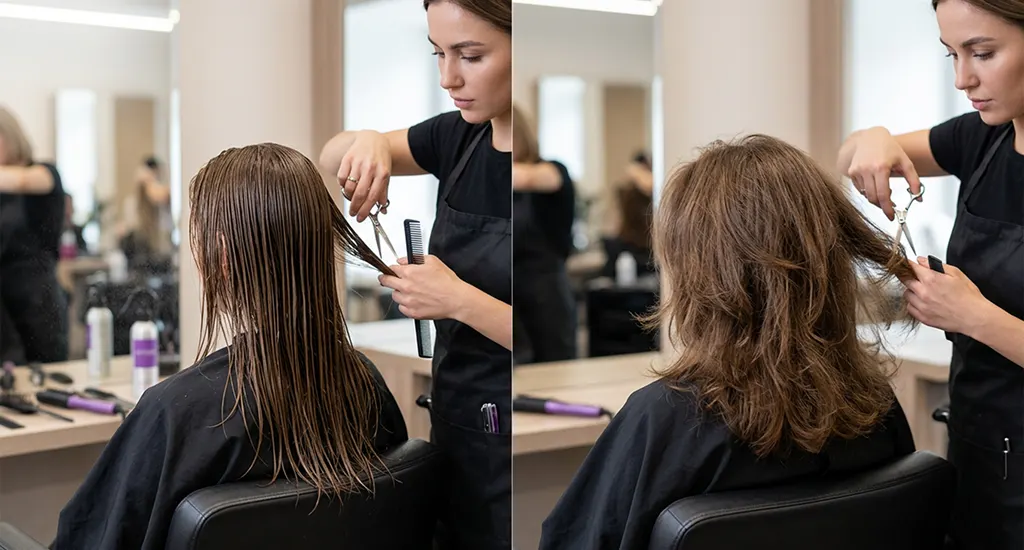
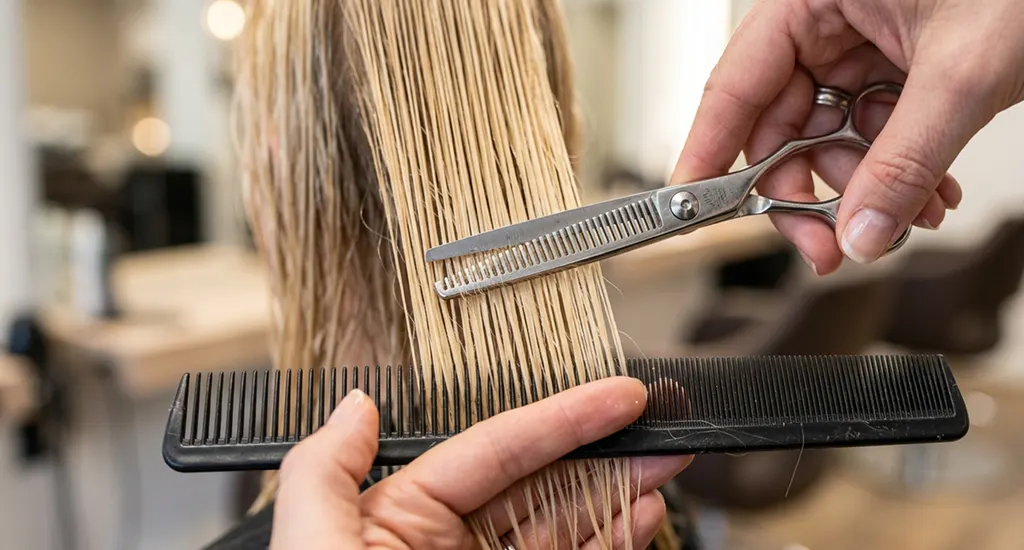
A wet haircut is exactly what it sounds like. Your stylist washes and conditions your hair, then works on it while it is still damp. Water and gentle tension keep the strands smooth, straight, and grouped into clean sections. The comb glides. The scissors follow a clear guideline.
Washing before the cut also strips away product buildup, oil, and hairspray. That matters because product-coated hair hides split ends and makes damage hard to see. A wet start gives the stylist a true read on your hair health.
Why Wet Hair Is Easier to Shape
Wet hair has more stretch. It behaves. It lies flat against your neck and shoulders. That flatness lets the stylist draw a straight line across the ends and trust that the line will hold. Blunt bobs, one-length lobs, and geometric shapes all depend on that stability.
The main reasons stylists reach for water first:
- Hair stretches and stays under tension.
- Strands stay flat and organized into sections.
- Guidelines are clean and repeatable.
- Sharp, blunt finishes are easier to lock in.
- Symmetry is easier to check side to side.
What Happens During a Dry Haircut
A dry haircut skips the shampoo bowl at the start. The hair stays in its natural, dry state. Your stylist can see the exact way your curls spring, your layers stack, and your ends actually sit against your face.
This is the method that has grown fast in the curly hair community. It is also the method most stylists use for finishing touches after a wet cut.
The Techniques Stylists Use on Dry Hair
Dry cutting is not a single motion. It uses several small techniques that a wet cut hides:
- Point cutting: scissors angle into the ends to soften a blunt line.
- Slide cutting: the blade slides down a section to remove weight without changing length.
- Dusting: quick removal of split ends across the whole head.
- Carving: shaping curl-by-curl on textured hair.
- Deep point cutting: heavier notching for movement in thick hair.
Why Dry Cutting Shows True Length
Wet hair can hang up to 50% longer than the same hair dry. Curly hair can shrink 20% to 90% depending on curl pattern and porosity. If you cut curly hair at wet length, the finished cut may look far shorter than you expected once it dries.
Dry cutting removes that guesswork. The stylist sees the exact spring factor of each curl, the exact weight sitting in the ends, and the exact way your layers fall. The result matches the mirror on day one, not day three after your first wash.
Wet Cutting: Full Pros, Cons, and Ideal Uses
Benefits of Cutting Hair Wet
Wet cutting is the workhorse of a salon. It gives the stylist maximum control, and it is the fastest way to reset a shape that has grown out unevenly.
Wet cutting is best for:
- Blunt bobs and lobs.
- A-line cuts with a clean back angle.
- One-length trims.
- Fine hair that needs even, symmetrical ends.
- Structured geometric shapes.
- A full reset after growing out an old cut.
Drawbacks of Wet Cutting
Wet hair stretches. It looks longer than it really is. On curly and wavy hair, that stretch hides the curl pattern, which is exactly what you need to see if you want your layers to sit right.
Layered cuts done fully wet can end up unbalanced because the stylist cannot see how the layers stack once the hair dries and bounces up. A curl that seems perfect at damp length can spring three inches shorter after drying.
Who Should Choose Wet Cutting
Wet cutting suits straight and fine hair, blunt cut lovers, and anyone who wants a crisp, tailored finish. It also suits clients who have not had a real reset in a while and need a clean structure back in shape.
For clean, precise wet cuts by stylists who know how each hair type responds, visit the haircut service at Salon 221.
Dry Cutting: Full Pros, Cons, and Ideal Uses
Benefits of Cutting Hair Dry
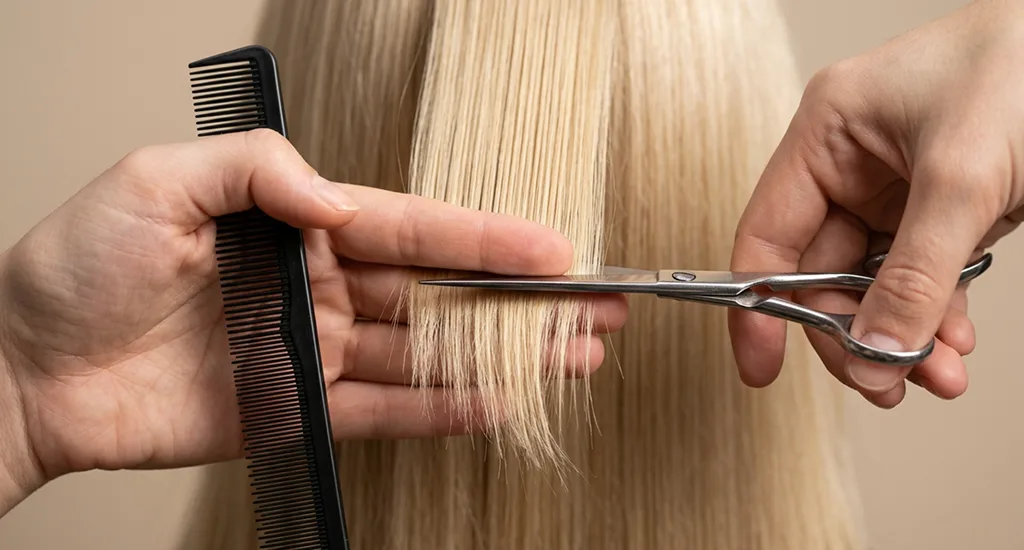
Dry cutting shows the truth. You and the stylist watch the shape happen in real time. There is no guessing what the cut will look like after a blow-dry, because the hair is already in the state you wear it every day.
Dry cutting is best for:
- Curly hair (Type 3 and Type 4).
- Wavy hair with an unpredictable pattern.
- Thick hair that needs weight removed in specific spots.
- Long layers and face-framing pieces.
- Bang trims between full appointments.
- Split-end dusting.
- Refining an existing shape rather than resetting it.
How Dry Cutting Prevents Over-Cutting
The stylist sees the exact length in real time. No hidden stretch, no guessing. Each curl sits where it will sit tomorrow, so nothing gets cut shorter than you asked for.
This is why dry cutting reduces regret. Wet cuts on curls can look correct in the chair and then shrink into a shape that feels too short at home. Dry cutting closes that gap.
Drawbacks of Dry Cutting
Dry hair does not stay perfectly flat. That makes a truly sharp, ruler-straight line harder to achieve. A very blunt bob is not the ideal candidate for a fully dry cut.
It also asks more of the stylist. Dry cutting needs strong skills, steady hands, and a clear read on the client’s hair type. It is not a shortcut. Done poorly, it produces a shape that looks choppy instead of soft.
Who Should Choose Dry Cutting
Curly and coily clients who want to avoid uneven shrinkage should ask for a dry cut. So should anyone be tired of the triangle shape, the frizzy layer, or the surprise inches missing after wash day.
Fine hair benefits too. Dry cutting lets the stylist see weight distribution and stop before too much bulk comes out.
For clients with curls who want a smoother texture between cuts, a keratin treatment can extend the shape and cut down frizz.
The Hybrid Method: Cut Wet, Refine Dry
Ask most experienced stylists what they actually do, and the answer is: both. They start with a wet cut to lock in the base shape and even out length, then blow-dry or air-dry the hair and finish with a dry cut.
The dry pass is where the shape becomes personal. Face-framing softens. Weight comes off the sides. Layers get carved so they move the way you wear your hair every day. The result is a cut that has clean bones and natural movement.
If you want the sharpest possible outcome, ask your stylist if they do a wet-then-dry finish. Most good ones already do.
Wet vs Dry Haircut: Side-by-Side Comparison
This table lays the two methods side by side so you can match your goal to a method.
| Point of Comparison | Wet Cut | Dry Cut |
| Hair Condition | Damp with water | Natural, dry state |
| Best For | Straight, fine, blunt shapes | Curly, coily, thick, textured |
| Line Precision | Very high, sharp, and clean | Softer, more natural |
| Shrinkage Risk | Real risk on curls | None, real length is visible |
| Curl Pattern Visibility | Hidden under water and tension | Fully visible |
| Weight Assessment | Hard to judge | Easy to judge in real time |
| Layer Accuracy | Layers may sit unevenly when dry | Layers sit exactly as cut |
| Face-Framing | Approximate | Precise |
| Bang Trims | Possible but risky | The safer, cleaner choice |
| Split-End Dusting | Not effective | Fast and effective |
| Skill Demand on Stylist | Standard salon training | Advanced skill required |
| Common Uses | Full resets, blunt bobs, symmetry | Refinement, curls, softening |
| Hybrid Fit | Ideal starting method | Ideal finishing method |
By Hair Type: Which Method Suits You
Straight Hair
Straight hair sits flat, wet or dry, but wet cutting still edges out. Damp strands make it easier to get a ruler-clean line, which is the whole point of straight hairstyles. Ask for a wet cut with a dry finish for balance.
Fine or Thin Hair
Fine hair looks fuller when the ends are blunt. A wet cut delivers that blunt line. Ask the stylist to skip aggressive thinning shears and to check density during a short dry pass so nothing gets over-removed.
Wavy Hair
Waves are unpredictable. A hybrid works best. Start wet for shape, finish dry so the stylist can see how each wave sits after air-drying. You avoid weird flips and uneven ends.
Curly Hair
Curly clients almost always benefit from a dry cut. The stylist reads each curl one by one, respects the spring factor, and shapes without shrinkage surprises.
For curly clients in South Florida humidity, see the keratin treatment guide for curly hair in Florida for a smoother finish between cuts.
Coily Hair
Type 4 hair can shrink 70% to 90% when it dries. Wet cutting that shrinkage risk into a short crop is heartbreak waiting to happen. A dry cut on stretched coils is the safer route.
Thick Hair
Thick hair needs weight taken out in specific places, not everywhere. A dry cut lets the stylist see exactly where the bulk sits and remove only what needs to go. A wet cut can strip too much.
For style ideas that flatter thick hair, browse modern haircuts for thick hair.
By Cut Style: What to Ask For
Blunt Bobs and A-Lines
Wet cut. No question. The line is the whole style, and water gives that line its edge. A quick dry check at the end catches anything that shifted.
Long Layers and Face-Framing
Hybrid. Wet base cut, then dry layering. Face-framing is a dry-cut craft because the stylist needs to see how each piece hits your cheekbone and jaw in real time.
If you are thinking about growing out or reshaping your fringe, see long bang hairstyles for women.
Curly Cuts
Dry cut, start to finish. Some stylists do a hybrid on wavy-curly hair, but true Type 3 and Type 4 curls should stay dry.
Bang Trims and Small Refreshes
Dry. Always. Wet bangs sit longer than dry bangs, and cutting to wet length is how eyebrows disappear.
Pixies and Short Cuts
Hybrid. The base shape comes from a wet cut. Texture, softness, and how the crown falls all come from the dry finish.
Hair Shrinkage: The Science Behind the Surprise
Shrinkage is not damage. It is a sign of healthy elasticity. When hair holds moisture, it stretches longer wet, then contracts back to its natural length as it dries. Curl pattern and porosity decide how big that contraction feels.
Straight hair shrinks a little. Wavy hair shrinks more. Loose curls (Type 3A) can shrink 30% to 50%. Tight coils (Type 4C) can shrink 70% to 90%. If your stylist cuts to wet length without accounting for spring back, your finished cut will look far shorter than the length you saw at the sink.
This is why dry cutting or a hybrid is the safer bet for anyone with real curl or coil in their hair. What you see is what you get.
The Triangle Problem in Curly Cuts
The triangle shape happens when the crown of the head sits close, but the ends of the curls sit wide. It is a classic side effect of wet cutting on curly hair. The stylist cannot see the crown volume because water flattens it, so all the weight ends up at the bottom.
Dry cutting fixes this. The stylist carves weight through the mid-lengths and lets the top expand into its natural shape. The result is a rounder, balanced silhouette.
Common Mistakes to Avoid
- Asking for a fully wet cut on curly hair without accounting for shrinkage.
- Skipping the dry finish on a blunt bob and missing the last inch of asymmetry.
- Cutting your own bangs wet at home, which almost always ends up too short.
- Assuming layers will fall the same wet and dry when they will not.
- Booking a full reset with a stylist who has not seen your hair air-dry.
- Requesting thinning shears on fine hair, which removes body you cannot get back.
Pro Tips Before Your Cut
- Arrive with clean, product-light hair so your stylist can read the real texture.
- Bring a photo. Better yet, bring two: one of the shape you want and one of the movement you want.
- Tell your stylist how you wear your hair day to day, not how you wear it for special events.
- If you have curls, ask if the stylist does a dry pass. If they do not, ask why.
- Ask for a mirror check on both sides before you leave the chair.
- Book a bang trim between full appointments to keep the shape sharp.
Wet or Dry Cut in Jupiter, FL
Every head of hair is different. That is why the team at Salon 221 in Jupiter, Florida, uses the method that suits your hair type, your goal, and your day-to-day style, not a one-size-fits-all approach. Blunt bobs get a clean wet cut. Curly clients get a full dry cut. Most others get a hybrid finish for both structure and movement.
Call (561) 469-1869 or request an appointment to book a cut with a stylist who will match the method to your hair, not the other way around. Salon 221 is at 221 Greenwich Cir, Suites 102 and 111, Jupiter, FL 33458.
Conclusion
There is no single winner in the wet vs dry haircut debate. Each method solves a different problem. Wet cutting delivers structure and clean lines. Dry cutting protects your true length and preserves the way your hair actually moves.
The best haircut you will ever get is the one where your stylist picks the method based on your hair type, your target style, and how you live in your hair every day. If a stylist reaches only for water or only for scissors on dry strands, they are working with a smaller toolbox than your hair deserves.
For a cut that matches you, not a rule, book with the team at Salon 221 in Jupiter, FL.